
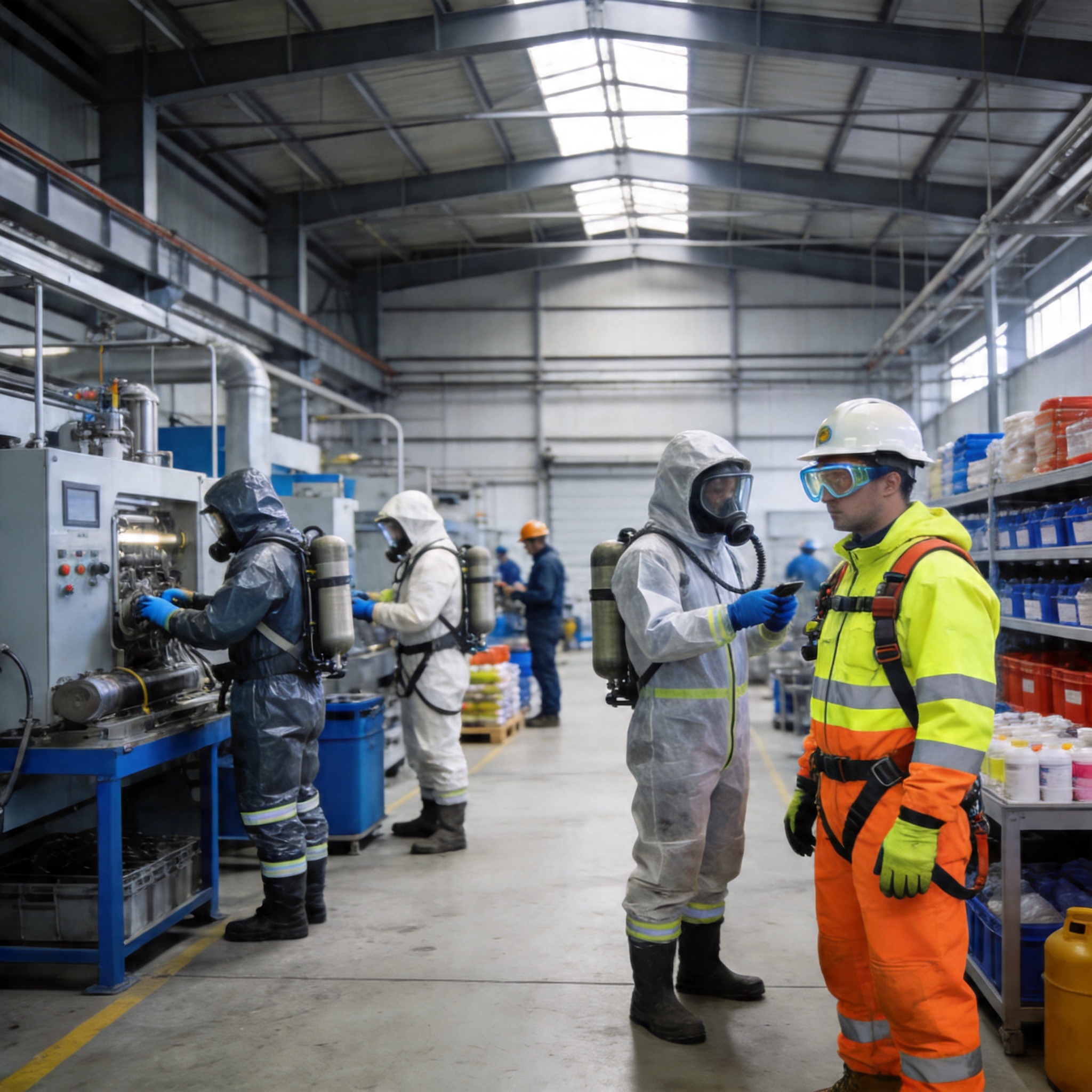
In industrial production, workers often face various hazards: chemical substances, high temperatures, static electricity, mechanical injuries, and more. A suitable protective suit not only effectively reduces occupational risks but also improves work efficiency and protects employee health.
#
1.1 Importance of Protective Suits
#
1.2 Consequences of Wrong Selection
Choosing unsuitable protective suits may result in:
Industrial protective suits come in various types based on their protective functions:
#
2.1 Acid-Resistant Workwear
Application: Chemical, electroplating, laboratory industries handling acid-base chemicals
Protection Principle: Uses acid-resistant coating materials to block liquid penetration
Classification:
Shanghai Jinling Recommended Products:
#
2.2 Gas Protection Suits
Application: Toxic gas, dust environments, emergency rescue
Protection Principle: Fully enclosed design used with air supply systems
Types:
Shanghai Jinling Recommended Products:
#
2.3 Anti-Static Workwear
Application: Petroleum, chemical, electronics, gas stations with static hazards
Protection Principle: Conducts static electricity through conductive fibers to prevent static accumulation causing accidents
Key Indicators:
Shanghai Jinling Recommended Products:
#
2.4 Waterproof Workwear
Application: Water conservancy, fisheries, mining, metallurgy with wet or water operations
Protection Principle: Uses waterproof coatings and sealing processes to prevent water penetration
Product Features:
Shanghai Jinling Recommended Products:
#
2.5 Rainwear Series
Application: Outdoor operations rain protection
Product Types:
#
3.1 Define Protection Needs
Before choosing protective suits, clarify these questions:
#
3.2 Understand Protection Levels
According to national standards, protective suits have clear level classifications:
Acid Protection Levels:
| Level | Application Environment | Performance Requirement |
|-------|----------------------|-------------------------|
| Level 1 | High concentration acid splash | Penetration time ≥ 60min |
| Level 2 | Medium concentration acid splash | Penetration time ≥ 30min |
| Level 3 | Low concentration acid splash | Penetration time ≥ 10min |
Chemical Protection Levels:
| Level | Protection Capability | Applicable Scenario |
|-------|----------------------|---------------------|
| Level A | Highest protection | Unknown environments, IDLH environments |
| Level B | Higher protection | Known respiratory hazards |
| Level C | General protection | Known skin hazards |
| Level D | Minimum protection | No hazard environments |
#3.3 Consider Comfort Performance
Protective suits should have comfortable wearing experience along with good protection:
Protective suits should have comfortable wearing experience along with good protection:
#
3.4 Check Certification Standards
When purchasing protective suits, verify product certifications:
Domestic Certifications:
International Certifications (for export needs):
#
4.1 Chemical Industry
Main Risks: Acid-base chemicals, toxic gases, high temperatures
Recommended Configuration:
Key Focus: Protection level, sealing performance, corrosion resistance
#
4.2 Petrochemical Industry
Main Risks: Flammable and explosive, static electricity, chemicals
Recommended Configuration:
Key Focus: Anti-static performance, fire and explosion protection level
#
4.3 Mining Industry
Main Risks: Moisture, dust, mechanical injuries
Recommended Configuration:
Key Focus: Waterproof performance, wear resistance, reflective effect
#
4.4 Electroplating Industry
Main Risks: Acid-base solutions, high temperatures, corrosion
Recommended Configuration:
Key Focus: Acid resistance level, sealing, protection area
#
4.5 Outdoor Operations
Main Risks: Rain, wind, ultraviolet radiation
Recommended Configuration:
Key Focus: Waterproof performance, breathability, visibility
#
5.1 Proper Wearing
When wearing protective suits:
#
5.2 Usage Precautions
#
5.3 Cleaning and Maintenance
Different material protective suits have different cleaning requirements:
Neoprene Coating:
PVC Coating:
#
5.4 Storage Requirements
#
6.1 Disposal Standards
Protective suits should be disposed in these situations:
#
6.2 Replacement Cycle
| Product Type | Recommended Replacement Cycle |
|--------------|------------------------------|
| Acid-resistant workwear | 1-2 years |
| Gas protection suits | 2-3 years |
| Anti-static workwear | 2-3 years |
| Rainwear series | 1-2 years |
Note: Specific replacement cycles should be determined based on actual usage and testing results
Q: Can protective suits be cleaned and reused?
A: Most protective suits can be cleaned and reused, but cleaning should follow instructions to avoid damaging protective coatings.
Q: How to determine if protective suits have failed?
A: You can determine through:
Q: Can protective suits be customized?
A: Yes. Shanghai Jinling provides customization services including size, color, Logo printing, and more.
Q: How to choose protective suit sizes?
A: It is recommended to choose according to size charts based on height and weight. Custom sizes are available for special body types.
Product Assurance:
Professional Services:
Customization Services:
Choosing the right industrial protective suit is an important measure to ensure worker safety. When purchasing, consider comprehensively:
Shanghai Jinling Rubber Products Co., Ltd. has been specializing in industrial protective equipment R&D and production for over 20 years, with products exported to more than 50 countries and regions worldwide. We are committed to providing customers with high-quality, cost-effective protective equipment and comprehensive service support.
For any purchasing questions, please feel free to contact us!
Industrial protective suitProtective suit selectionSafety protectionOccupational health
图片加载失败
Protective Suits
Double Coated Acid-Resistant Two-Piece Suit (3015)
Double coated acid-resistant two-piece work suit, featuring nylon filament fabric with neoprene rubber coating, providing protection against acid, alkali, and chemical solvents. Suitable for chemical, laboratory environments.
Double-sided coating protectionTwo-piece design for easy wearAcid and alkali resistant
图片加载失败
Protective Suits
Double Coated Acid-Resistant Long Suit (3019)
Double coated acid-resistant long work suit, featuring nylon filament fabric with neoprene rubber coating, providing comprehensive protection against acid, alkali, and chemical solvents. Ideal for chemical and laboratory settings.
Long full-body protectionDouble-sided coatingHigh-strength wear-resistant
图片加载失败
Protective Suits
Acid-Resistant Two-Piece Suit (3088)
Acid-resistant two-piece work suit with all-cotton inner fabric and double-sided neoprene coating, offering protection against acid, alkali, and chemical solvents. Two-piece design allows easy wearing and removal.
100% cotton comfortable liningTwo-piece for easy wearEconomical and practical
Comments
No comments yet. Be the first to comment!